常见问题
目录
关于项目
了解项目
事工中心将回应什么样的需求和可能?
上帝赐给了圣保罗教会一个非凡的事工机会。越来越多的家庭来到这里,我们的儿童和青年事工已经面临空间压力,目前许多场地已经达到甚至超出了可容纳的容量。
事工中心的重点并不主要是为了让大家更舒适,而是为了儿童和青年人预备空间,让他们能够听见耶稣的福音;让来到我们当中的家庭受到更好的欢迎;让成长小组和培训能够在合适的空间中进行;并为那些我们现在还无法想象的事工预留空间。
我们是如何一步步走到今天这个项目阶段的?
2019年落成的北礼堂,一直都是整体扩建计划的第一阶段,为成人会众提供了急需的聚会空间。
下一步,是重新回到尚未解决的儿童、青少年及行政办公空间需求。
建造事工中心项目的启动,既是为了回应教会长期的事工需要,也是在规划限制下所作出的回应。
项目的开发申请于2022年8月获批,并将于2027年8月到期。2025年11月,早期支持者承诺捐款,用于详细设计,并弥补此前已投入的开发申请相关费用。 进入2026年,随着详细设计、成本规划及募款活动筹备工作的推进,这个项目已进入全教会共同回应的阶段。
我们曾考虑过哪些其他方案?
我们曾评估过几种不同的方案:将行政办公搬到教会以外的地点(把员工办公室迁往其他地方)、在其他地方植堂(建立新的教会群体)、增加聚会时段(但受到儿童事工空间容量的限制),以及维持现状(但考虑到教会的增长、事工机会、现有设施日渐老化,以及我们有责任善用神托付给我们的资源来推动祂的国度,这并不是一个可持续的选择)。我们最终选择建造事工中心,因为它直接回应了目前最核心的限制:无论是现有还是未来的事工需要,我们都缺乏数量充足、质量合适的事工空间。
了解更多
我们评估过几种不同的方案:
- 将行政办公迁至教会以外: 将员工办公室搬到其他地点,以腾出更多教会空间用于事工。
- 在其他地方植堂: 在其他地区建立新的教会群体
- 增加聚会时段: 但受到現有的聚會及儿童事工空间容量的限制。
- 维持现状: 我们认为这并不是一个可持续的选择。随着教会持续增长,许多新的事工机会也跟着增加;同时,我们有责任善用神所托付给我们的资源来推动祂的国度。此外,现有设施,尤其是目前的行政办公室,也正日渐老化,需要面对实际的维修和更新问题。
我们决定继续推进建造事工中心的项目,因为它直接回应了目前最核心的限制:我们所缺乏的数量充足、合适的事工空间,既要满足当前的需要,也要为未来的事工发展做好准备。
我们已经认真考虑过各种替代方案。这样的项目拖得越久,成本只会越来越高;更不用说,如果目前已经获批的开发申请;失效,我们将面临巨大的风险。
2026年第3及第4学期会有哪些项目安排?
2026年第3及第4学期将是 「为世代建造」 全教会募款行动的主要阶段。
从八月中开始,我们将与教会会员一起举行 「为世代建造」茶话会。让大家一起观看主任牧师的视频、了解项目手册内容、提出问题,并一同祷告。
随后,教会内的项目活动将于10月25日正式启动,并于 11月1日、8日及15日举行 「为世代建造」 主日。11月22日为「承诺主日」 — 这是我们全教会一起回应、参与这事工项目的日期。
灵象与设计
事工中心将带来什么?
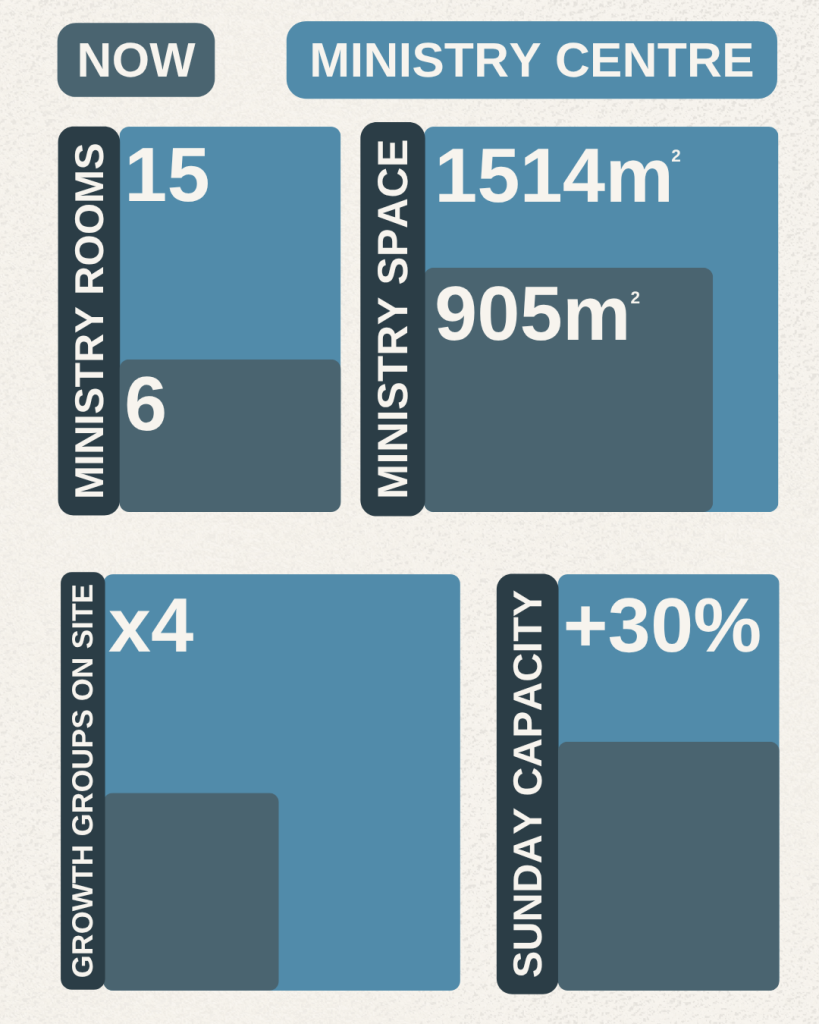
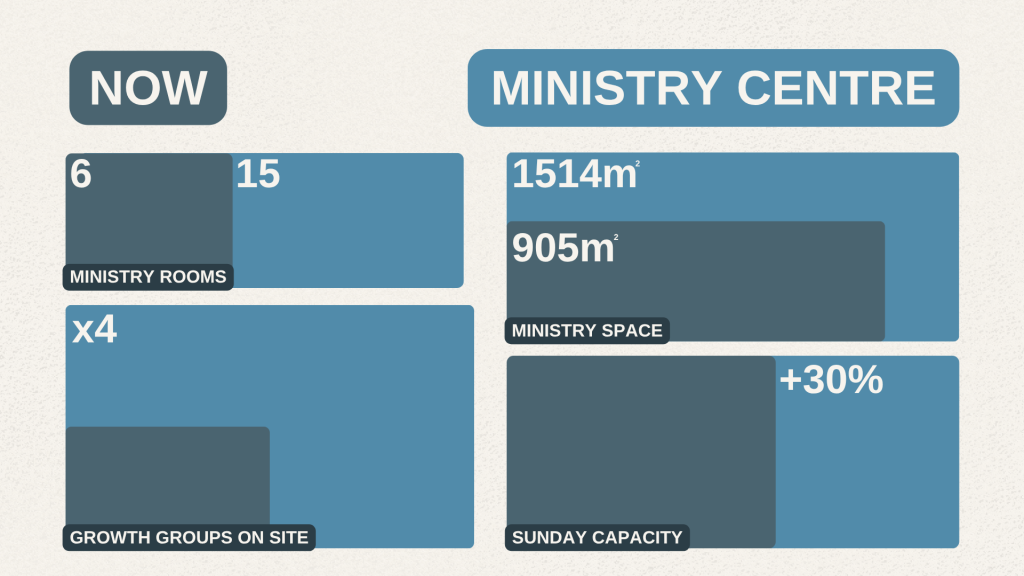
事工中心将立刻提供专为儿童而设的活动室、专属的青少年空间、灵活多用途的会议室,以及更合适的成长小组、英语班、事工培训和音乐活动空间。同时也将提供现代化的办公室,让行政工作更好地支持教会事工,而不是成为事工发展的限制。
随着时间推移,这些空间也将为新的聚会模式、更扎实的儿童和青少年教育、更有效地面向社区开展事工,以及未来世代所构想的新事工提供可能。
关键在于灵活性:这些空间既能满足当前的事工需要,也能回应未来福音事工的各种机会。
了解更多
对于教会现状的益处:
- 专为儿童而设的空间,配备符合不同年龄需要的设施,帮助儿童在信仰上受到教导和塑造(包括在学龄前儿童活动室内设置儿童洗手间)
- 青少年专属空间,既能容纳大型聚会,也适合小规模、分组式的聚会,帮助青少年在基督里成长,成为祂的门徒
- 更适合扩展 英语班等事工的设施
- 灵活的会议室,供成长小组及其他小组事工使用
- 现代化的行政办公空间,促进团队协作,提高事工的成效
未来的可能性:
- 新的英文家庭堂聚会时间,可以与中文堂同时聚会,并在目前的英文家庭堂的基础上继续成长
- 更丰富的社区服务和外展事工,包括一些我们目前还未想到、甚至还未祷告求问的事工机会
- 事工培训与装备的机会
- 为未来教会植堂打稳基础,让我们能够在教会稳健发展的基础上迈向新的事工领域
- 开展我们目前尚未想象到的新事工,服事不断增长的本地社区,让更多人认识主耶稣,成为祂的门徒
靠着神的帮助,我们要好好预备,迎接祂要带来的福音事工。
事工中心将包括哪些具体空间?
目前的设计包括专为儿童事工而设的活动室、既可用于大型聚会,也适合小组讨论的青少年空间、灵活多用途的房间,可用于成长小组、查经、培训、英班及社区活动;此外还包括员工办公室、团队协作空间、储藏空间,以及一个宽敞友善的入口和接待区。
了解更多
事工中心的设计重点是儿童和青少年事工,并与现有的 北礼堂相互配合。
儿童及青少年属灵培育空间:
- Purpose-built children’s ministry rooms designed for different age groups to enable education and spiritual formation
- Youth-focused spaces enabling both large gatherings and small group discussions to foster discipleship of teenagers
- Age-appropriate facilities with modern safety and accessibility features
- Flexible spaces that can be reconfigured for different programmes
Administrative Facilities:
- Modern office spaces replacing the current 1977 building (which was once a rectory) and other temporary buildings (yes, many of our staff currently work in relocatable buildings)
- Flexible meeting spaces without structural obstacles, like the pole in the middle of the admin building meeting room, to facilitate ministry and teamwork
- Modern facilities that don’t leak during heavy rain
Ancillary Ministry Spaces:
- Small group and breakout rooms for Growth Groups and other groups like ESL classes
- Storage solutions for children’s and youth equipment and resources
To provide an idea of scale: the Ministry Centre floor area will be three times larger than the North Hall, with the majority of space dedicated to these ministry areas and prioritised for youth and children’s educational ministries.
How flexible will these spaces be?
Whilst the design intent has been to cater for children’s and youth ministries, the design emphasises adaptability: flexible walls for adjusting to different group sizes (allowing various ministries to take place simultaneously), multi-purpose rooms that can serve various ministries and configurations, spaces that can accommodate both large gatherings and small breakout groups, and a combination of individual offices and open-plan office space with meeting rooms.
了解更多
Whilst the design intent has been to cater for children’s and youth ministries, the design emphasises adaptability:
- Flexible walls for adjusting to different group sizes, allowing various ministries to take place simultaneously
- Multi-purpose rooms that can serve various ministries and configurations
- Spaces that can accommodate both large gatherings and small breakout groups
- A combination of individual offices and open-plan office space with meeting rooms
How does this fit St Paul's 175-year history?
The Ministry Centre is our generation’s opportunity to continue the legacy we’ve received. Previous generations at St Paul’s built: 1850 (the original sandstone church), 1977 (sold North Rocks and Marsden Rd properties to fund building at Moseley St), 1988 (the then-North Hall), and 2019 (the expanded North Hall).
Now it’s our turn to embark on what was always intended to be Phase 2, building for future generations who will meet, learn and grow in these spaces, including people we may never meet.
As Psalm 145:4 says: “One generation commends your works to another; they tell of your mighty acts.”
了解更多
The Ministry Centre is our generation’s opportunity to continue the legacy we’ve received.
Previous generations at St Paul’s built:
- 1850: The original sandstone church
- 1977: Sold the North Rocks and Marsden Rd properties to fund building at Moseley St
- 1988: The then-North Hall
- 2019: The expanded North Hall (a unique, larger auditorium in the Sydney Anglican context with maximum capacity of 450 people)
Now it’s our turn to embark on what was always intended to be Phase 2, building for future generations who will meet, learn and grow in these spaces, including people we may never meet.
As Psalm 145:4 declares: “One generation commends your works to another; they tell of your mighty acts.” This is what we’re doing – building for generations we may never meet, so they too can know and serve Jesus.
Strategic direction
Why not plant new churches instead of building larger facilities?
20-25 years ago, St Paul’s did follow a church planting model and pioneered such an approach. However, after years of experience and prayerful reflection, leadership came to see real advantages in developing larger congregations. Some challenges included planting churches close to “home base,” staffing many children’s ministries, the work of setting up and packing up long term, and limited availability of suitable off-site spaces. The North Hall project was an outcome of this revised approach. The Building For Generations project will enable us to operate at a scale where we can plant from a position of strength, with facilities that enable intentional leader training and launching new congregations with solid foundations.
了解更多
Learning from Our Journey:
20-25 years ago, St Paul’s did follow a church planting model. St Paul’s was one of the Sydney Anglican churches to pioneer such an approach, and God brought much blessing. However, after years of experience and careful, prayerful reflection, our then-leadership came to see some real advantages in developing larger congregations. Some of the challenges included planting churches so close to “home base”; staffing so many children’s ministries; the work involved in setting up and packing up over a prolonged period of time; and the limited availability of suitable off-site spaces to support the strategy long term. Many churches around Sydney have walked a similar journey. It’s worth acknowledging the pain that many experienced as these plants were progressively closed. Nonetheless, the North Hall project was one of the outcomes of this revised approach as St Paul’s pivoted toward a larger congregation model.
The Opportunity of Larger Congregations:
Church size in itself is not a moral category, and there’s a need across our city and country for churches of all sizes. That said, the Lord has developed St Paul’s into a large church with larger congregations. Over the years, for example:
- St Paul’s has trained and sent over 100 MTS trainees to serve the Gospel around Sydney, Australia and the world
- Each term, our scale means we can run Christianity Explored. We’ve always seen people who are investigating Jesus actively participate
- Each week, we see scores of visitors, many who don’t know Jesus, and others who are searching for a new church home
- Whilst many churches need to make hard decisions about which ministries to focus on, St Paul’s has been able to provide “cradle to grave” ministries
- We’re able to operate children’s and youth ministries on some scale. This means there’s more opportunity for people to be spiritually formed in cohorts. Whilst, sadly, some fall between the cracks, this cohort development is so important to so many, particularly in a world where there’s so much pressure away from the Gospel. Many would testify to keeping up with their cohorts for years following youth ministry
- Whilst we always need more staff, we’re also able to have staff with specialist skills in respective areas, increasing the quality of the ministries we’re able to operate. One example is that we’re able to employ specialist youth and children’s pastors
- More people can be intentionally trained and equipped for ministry
- We can develop and maintain a critical mass of community presence – so many people in our area have heard of St Paul’s, and this provides an enhanced opportunity for people to be introduced to Jesus
We don’t see the choice between developing a large church and church planting as an either/or decision. We, and other churches, have learnt much about church planting. This has only come through being entrepreneurial and trying things. Our conviction is, at an appropriate time, to learn from the past and plant churches in sustainable ways in the future (a variation on this theme would be to develop a “multi-site” approach, like some other churches have). St Paul’s itself began as a church plant from Ryde Anglican church many decades ago.
The Building For Generations project will enable us to operate at a scale where we can plant from a position of strength, and with facilities that enable us to intentionally train leaders well and launch new congregations with solid foundations. In addition, we need to ensure that the ‘home base’ can recover quickly to further foster sustainable church planting.
Right now, we have an immediate opportunity to develop our infrastructure to better serve larger congregations with healthy and sustainable proportions of children and youth. We pray that the “bubble” we’re seeing in early Primary School will continue into upper primary years, and then into our SALT youth group. This creates a strong base from which future planting can happen effectively. With God’s help, we’re seeking to build wisely for both current and future ministry opportunities.
Have you considered alternative service structures?
Yes, we have. Right now, we’re constrained in doing so: we have Early Morning Church (7.45am), Morning Church (9:15am) and Mandarin Church (11.15am). Simply, there’s no more on-site capacity on a Sunday morning. Furthermore, we conducted a survey in 2023 that showed little interest in alternative times.
The Building for Generations project emerged as a way forward to enable and support more children and youth on site, as well as providing more space for other creative solutions.
Biblical and theological foundations
What does the Bible say about debt and giving?
Focus Group participants specifically asked, “What does God think about debt?” This reflects genuine theological interest, and we’re delighted by this appetite for biblical teaching on stewardship, debt and generous giving. We’ve responded by introducing monthly teaching spots addressing these questions with biblical clarity and practical application. On debt: The Bible doesn’t call debt a sin, but warns about its dangers. There’s an important distinction between borrowing to fund lifestyle beyond our means (clearly discouraged) and borrowing for assets that enable productive outcomes, particularly Gospel ones. On giving: Scripture consistently calls God’s people to generous, sacrificial giving. For 175 years, we’ve benefited from previous generations who gave sacrificially to build facilities we now enjoy.
了解更多
Focus Group participants specifically asked, “What does God think about debt?” This reflects genuine theological interest, and we’re delighted by this appetite for biblical teaching on stewardship, debt and generous giving. We’ve responded initially by introducing monthly teaching spots that address these questions with biblical clarity and practical application.
On Debt:
The Bible doesn’t call debt a sin, but it does warn about its dangers. Proverbs 22:7 reminds us that “the borrower is slave to the lender” because debt can create bondage and limit freedom. Romans 13:8 urges us to “let no debt remain outstanding, except the continuing debt to love one another.” Psalm 37:21 teaches that “the wicked borrow and do not repay, but the righteous give generously.” The biblical wisdom is to avoid debt where possible and repay it faithfully when unavoidable.
However, Scripture also recognises that some debt may be necessary or unavoidable: medical emergencies, caring for family (1 Timothy 5:8), or significant life circumstances. Proverbs 22:26-27 warns against carelessly guaranteeing debts, reminding us that wisdom requires careful consideration. The key biblical principle is faithful stewardship: can we service the debt responsibly without presuming on the future (James 4:13-15)?
There’s an important distinction between borrowing to fund lifestyle beyond our means (clearly discouraged) and borrowing for assets that enable productive outcomes, particularly Gospel ones. A mortgage that provides stable housing for your family, or a church building that enables gospel ministry for generations, is different from credit card debt funding unnecessary consumption. Proverbs 21:5 teaches that “the plans of the diligent lead to profit as surely as haste leads to poverty.”
Jesus’ parable of the talents (Matthew 25:14-30) teaches that God expects us to invest what He’s entrusted to us wisely, and for multiplication, not merely preserve it. The servant who buried his talent was condemned for failing to put resources to productive use. Sometimes, faithful stewardship means taking calculated steps, including appropriate and serviceable debt, to multiply kingdom impact.
On Giving:
Scripture consistently calls God’s people to generous, sacrificial giving. Paul writes in 2 Corinthians 9:7 that “God loves a cheerful giver,” and in 2 Corinthians 8:1-5 he describes the Macedonian churches giving “beyond their ability” out of joy. Jesus himself taught that where our treasure is, there our hearts will be also (Matthew 6:21). Proverbs 3:9 instructs us to “honour the Lord with your wealth, with the firstfruits of all your crops.”
Giving isn’t primarily about funding church operations; it’s about forming our hearts, expressing gratitude for God’s grace, and investing in eternal purposes. As 2 Corinthians 9:6 reminds us: “Whoever sows sparingly will also reap sparingly, and whoever sows generously will also reap generously.”
For 175 years, we’ve benefited from previous generations who gave sacrificially to build facilities we now enjoy. They built for people they would never meet. Many in our congregation today contributed generously to the North Hall, and we’re again being asked to exercise that same faithful stewardship, building for future generations who will gather, learn and grow in spaces we provide. As Psalm 78:4-7 reminds us, we are to tell the next generation “the praiseworthy deeds of the Lord” and establish His testimony, so that future generations “would put their trust in God.” This is biblical stewardship: faithful, generous, forward-looking and gospel-focused.
这对教会事工意味着什么
Ministry impact
How will this help children's and youth ministries?
The Ministry Centre is primarily designed to serve children’s and youth ministry needs and in particular, spiritual formation.
For children’s programmes: age-appropriate spaces instead of current constraints, purpose-built rooms enabling proper spiritual formation.
For SALT Youth Ministry: ability to meet as large group then split into 12 smaller year and gender-based groups (currently over 120 young people with noise spilling over between groups, restrictions on youth group models).
For Kids Holiday Club: small group space currently lacking will be provided (2025 sold out a month in advance; expansion will allow reaching more families with the Gospel).
了解更多
The Ministry Centre is primarily designed to serve children’s and youth ministry needs.
Children’s Programs:
Age-appropriate spaces instead of current constraints:
- At Morning Church we have 42 primary kids currently housed in East/West Hall
- Our spaces for pre-schoolers and crèche are almost at capacity
- Purpose-built rooms will enable more effective spiritual formation with adequate space and facilities
SALT Youth Ministry:
Ability to meet as large group then split into 12 smaller year and gender-based groups:
- At SALT, we have over 120 young people meeting each week
- Meeting in smaller cohort groups means that noise spills over from one group to another
- There are restrictions on the youth group models that can be adopted
- On Sunday afternoons, small SMS groups meet in several locations. It’s not uncommon for one group or another to be sitting outside, and this is the same time that a disability support group meets in the admin building
Kids Holiday Club:
Lacks small group space, which will be alleviated with the Ministry Centre:
- In 2025, it sold out a month in advance, with the majority of participants from outside of St Paul’s.
- Enabling expansion will allow us to reach more families with the Gospel, and help our own children in spiritual education and formation.
How will this help Growth Groups and other ministries?
Growth Groups: Multiple small meeting rooms available simultaneously, ending the current constraint where groups compete for limited space or are forced to meet offsite.
ESL Programmes: Dedicated classroom-style spaces with proper facilities for language learning and introducing people to Jesus.
Smoother Transitions Between Services: More space will ease the challenge of rapid Sunday transitions from one service to another, with dedicated foyer space.
Music Ministries: Currently teams can rehearse in challenging circumstances; more spaces will alleviate these issues.
New Ministries: More space will allow exploring opportunities from our growing local population and prayerful creativity for ministries not yet imagined.
了解更多
Growth Groups:
Multiple small meeting rooms available simultaneously, ending the current constraint where groups compete for limited space or are forced to meet offsite. This dynamic is only expected to worsen, with many groups becoming increasingly limited by the size of lounge rooms. In addition, more churches are starting to have larger groups (as are we with, for example, WOW – think of the format of Wednesday Women expanding to other times in the week). We need suitable space to enable this to happen.
ESL Programmes:
Dedicated classroom-style spaces with proper facilities for language learning and the possibility of then introducing people to Jesus. Already, Victor is running a post-ESL easy English bible study.
Smoother Transitions Between Services:
St Paul’s is a busy space on Sundays, as we rapidly transition from one service to another (Early Morning Church to Morning Church to Chinese Church to Chinese Church small groups to Afternoon Church to Night Church). Noise from post-church gatherings in one congregation impacts the incoming one. We lack a dedicated foyer space with people moving in and moving out all at the same time. It becomes more than a little challenging for drivers’ meetings, leaders’ training, music rehearsals, small groups, and the list goes on.
Music Ministries:
Currently, our music teams can rehearse in challenging circumstances (thank you to all involved!), and some groups have to move quickly from a make-shift rehearsal space and then set up for church. Rehearsal opportunities at other times can be challenging to come by. More spaces will alleviate these issues.
New Ministries:
More space will allow us to explore the opportunities that our growing local population will bring, as well as the prayerful brainstorming and creativity for ministries that haven’t yet been imagined.
How will staff working conditions improve?
Currently, many staff work in old or temporary buildings (come and take a look!).
The 1977 administration building (originally a rectory) has reached end of useful life with water leaks and electrical issues. More than that, staff are spread out in various buildings, which can feel like ‘ships passing in the night’, far from optimum for collaboration.
The Ministry Centre will foster collaborative teamwork by providing: modern office spaces in a purpose-built facility, improved communication through better proximity and shared spaces, proper meeting facilities for planning, and administrative efficiency that supports rather than constrains ministry.
了解更多
Currently, many of our St Paul’s staff team work in old or temporary buildings (come and take a look!).
The administration building, built in 1977 and originally a rectory, has reached the end of its useful life. In the rain, it has water leaks and can have electrical issues. More than that, the staff team are spread out in various buildings. It can be easy to feel like ‘ships passing in the night’, far from an optimum environment for collaboration and teamwork.
The Ministry Centre will foster a collaborative staff team environment that enhances teamwork by providing:
- Modern office spaces in a purpose-built facility
- Improved staff communication through better proximity and shared spaces
- Proper meeting facilities for planning and coordination
- Administrative efficiency that supports, rather than constrains, ministry
We want to create spaces that facilitate collaborative ministry.
Stewardship and priorities
Shouldn't we spend money on charitable works instead?
We’re not choosing between building and ministry, or building and charitable works. We’re delighted that the people of St Paul’s support almost 350 Compassion children in the Philippines (amounting to some $230,000 annually), our partnership with Berkeley Life Centre, hosting Anglicare clothing bins, annual Toys and Tucker food drive, ministries such as Play Circle and ESL classes, and more. We’re very active in charitable works already, and the Building For Generations project will enhance our ability to do so in existing ways, as well as provide infrastructure for future generations to do so in new ways that haven’t yet been dreamt up or prayed about. The choice isn’t an either/or one – theologically, charitable works are an outworking of the Gospel and a way to express the love of Jesus to our world.
了解更多
We’re not choosing between building and ministry, or building and charitable works. We’re delighted, for example, that the people of St Paul’s support almost 350 Compassion children in the Philippines (amounting to some $230,000 annually), as well as our ongoing partnership with Berkeley Life Centre, which includes supporting their Op Shop. On top of this, we host Anglicare clothing bins and our annual Toys and Tucker food drive. Furthermore, we run ministries such as Play Circle and ESL classes. We also more directly support those in need as circumstances arise. Each year, our facilities are used as a staging area to organise gift packs for thousands of Sri Lankan orphans.
We’re very active in charitable works already, and the Building For Generations project will enhance our ability to do so in existing ways, as well as provide infrastructure for future generations to do so in new ways that haven’t yet been dreamt up or prayed about. Currently, sometimes we’re restricted in space so that it must be an either/or choice. More space will enable more multiple and simultaneous opportunities. We’re excited to contemplate the possibilities.
The choice isn’t an either/or one. At one level, they both work together because, theologically, charitable works are an outworking of the Gospel and a way to express the love of Jesus to our world with the ultimate aim of people knowing Jesus as Lord and Saviour.
Does this reflect poorly on our stewardship?
Proceeding with the Building for Generations project at this time is good stewardship: seizing ministry growth opportunities while there’s momentum, locking in construction costs before they escalate, using our DA approval before it expires, addressing facility deterioration before costs escalate, assisting with a collaborative environment for our staff team, and utilising significant tax-deductible giving opportunities. Our experience with the North Hall has been that purpose-built facilities communicate that the Gospel and church remain vibrant and relevant. Throughout our 175-year history, visionary investment in ministry infrastructure has been both normal and necessary.
了解更多
Proceeding with the Building for Generations project at this time is good stewardship. Doing so:
- Seizes ministry growth opportunities while there’s momentum, particularly among young families
- Locks in construction costs before they further escalate
- Uses our DA approval before it expires (August 2027), preventing the cost and risk of resubmitting a fresh DA
- Addresses facility deterioration of the admin building before costs escalate further
- Assists with a safe, effective, collaborative environment for our staff team to lead our church
- Utilises significant tax-deductible giving opportunities through the Ministry Centre project’s ATO-approved “School Building Fund” status
Our experience with the North Hall has been that the purpose-built facility has actually communicated that the Gospel and church remain vibrant and relevant in our community. It’s enabled ministry growth that wouldn’t have been possible otherwise. Throughout our 175-year history, visionary investment in ministry infrastructure has been both normal and necessary. We’re here today because previous generations made courageous and costly building decisions, often when they couldn’t fully see the long-term impact. They invested in the Gospel, which would impact people they hadn’t or wouldn’t even meet. This is the kind of inspiration we have the opportunity to emulate.
Are we just spending money to be more comfortable?
We must certainly be careful not to make such decisions to be more comfortable – this is a trap many churches have found themselves in. That said, the motivation with the Building For Generations project is to respond to genuine ministry constraints and opportunities, particularly for children and youth ministries and spiritual formation. The North Hall served adults. This Ministry Centre is primarily about serving youth and children. Right now, children and youth are learning about Jesus in spaces that aren’t appropriate for their needs and lack sufficient space. The cost of doing nothing is also significant, as we lose ministry opportunities during a time when our community is growing all around us. As the parable of the talents teaches us (Matthew 25:14-30), God wants us to invest what He’s entrusted to us for kingdom multiplication.
了解更多
We must certainly be careful not to make such decisions to be more comfortable. This is a trap that many churches have found themselves in.
That said, the motivation with the Building For Generations project is to respond to genuine ministry constraints and opportunities, particularly when it comes to children and youth ministries and spiritual formation. The North Hall served adults. This Ministry Centre is primarily about serving youth and children. Other groups will incidentally benefit too. However, this project is primarily about developing an up-to-date facility to serve and enable spiritual formation for the children and youth of both today and tomorrow. Right now, children and youth are learning about Jesus in spaces that aren’t appropriate for their needs and lack sufficient space.
In addition, our staff and volunteers are trying to work and collaborate effectively despite being hampered by inadequate facilities. Small groups can’t form or expand because there’s nowhere for them to meet. Meanwhile, our 50-year-old administration building has reached the end of its useful life.
The cost of doing nothing is also significant, as we lose ministry opportunities during a time when our community is growing all around us. We need only look at the cranes in the area that are quite literally building high-density housing on our doorstep. The Building For Generations project is about providing infrastructure for decades to come.
This isn’t about enhancing comfort (although it will!). It’s about effective stewardship of the Gospel opportunities God has placed before us, seeking to multiply the enormous resources that the Lord has entrusted us with.
As the parable of the talents teaches us (Matthew 25:14-30), God wants us to invest what He’s entrusted to us for kingdom multiplication, not merely preserve it.
Getting involved
How can I pray for this project?
Prayer Partnership: Join us in praying for: Wisdom in planning (James 1:5), Unity across our church family (Psalm 133:1), God’s provision through His people’s generous giving (Philippians 4:19), Protection from division or discord, That God would be glorified in the whole process, That the Ministry Centre would enable gospel faithfulness and fruitfulness for generations. Prayer is foundational to this entire process.
How can I learn more?
Join a Building for Generations Chat, read the Information Booklet, participate in one or more Q&A sessions, and speak with Ministry Leaders.
了解更多
Attend Information Sessions: We’ll continue providing regular updates through Raj’s monthly communications at services, as well as special information sessions and appropriate project briefings as we progress through each phase.
Visit Morning Church: If you attend other services, consider visiting Morning Church one Sunday to observe current space constraints firsthand. See the Den where you might struggle to stand upright, the shipping containers housing staff, and the creative ways we’re working around current structural limitations. Understanding the current reality helps clarify why we’re pursuing this project.
Speak with Ministry Leaders: Talk with those involved in children’s ministry, youth programmes, or small groups about the practical constraints they navigate each week. Parish Council members, particularly those from Morning Church, can share their firsthand experience of the space limitations affecting ministry effectiveness.
How can I contribute beyond financial giving?
Consider Your Contribution: Reflect prayerfully on how you might contribute skills, energy and resources to this project. This might include: hosting a Chat, providing hospitality, administrative support, prayer, inviting and encouraging others, and helping the team collect questions.
Engage with Working Groups: If you have specific expertise or interest in particular aspects of the project, consider how you might contribute to the various working groups.
了解更多
Consider Your Contribution: Reflect prayerfully on how you might contribute skills, energy and resources to this project. This might include hosting a Chat, providing hospitality, handling administration, leading prayer, inviting and encouraging others, and helping the team collect questions.
Engage with Working Groups: If you have specific expertise or interest in particular aspects of the project, consider how you might contribute to the Strategy and Project Control Group, Fundraising and Communications Working Group, Design Working Group, or Finances Working Group. In due course, we’ll also need an Operations Group to manage during the construction process.
How should I think about financial contributions?
Begin with prayer.
Consider your regular giving to ongoing ministry first, because that supports the day-to-day ministry and operations of St Paul’s. Then ask what sacrificial partnership in Building for Generations could look like for you or your household.
We are not asking everyone to give the same amount. God has blessed each person and family differently.
The encouragement is equal sacrifice, not equal gifts.
People can give through a one-off gift, a pledge over time, a bequest, or a combination.
了解更多
Financial Contributions: Take time to pray about your family’s or individual capacity to participate financially. The biblical encouragement is toward generous, sacrificial giving according to what God has provided, not according to a fixed formula. Some will give more, others less, according to God’s work in your heart, your capacity and stewardship of what the Lord has entrusted to you.
Consider:
- Praying and asking God what He would have you give
- Discussing with your spouse or family
- Looking at your budget to see what’s possible
- Considering both one-off gifts and pledges over time
- Exploring whether tax-deductible giving through the School Building Fund might enable you to give more
- Remembering this is in addition to, not instead of, your regular Ministry Budget giving
As 2 Corinthians 9:7 reminds us: “Each of you should give what you have decided in your heart to give, not reluctantly or under compulsion, for God loves a cheerful giver.”
What should I do between the consultation and Commitment Sunday?
Take the booklet and summary sheet home.
Pray.
Talk it over with your spouse, family, growth group or trusted Christian friends.
Consider your regular giving to ongoing ministry first, then prayerfully ask what sacrificial partnership in Building for Generations might look like for you.
If you are considering a substantial tax-deductible gift through the School Building Fund, you may wish to seek your own financial or tax advice.
What are the ways I can give?
There are three main pathways:
(1) a one-off gift on or before Commitment Sunday;
(2) a pledge to give regularly over three years; and
(3) a bequest.
Some people may use a combination.
Building for Generations giving should be in addition to regular weekly giving, because regular giving funds the ongoing ministry and operations of St Paul’s.
项目将如何发生
Timing and deadlines
Why now? What happens if we miss the August 2027 deadline?
We’ve made various enquiries and have been advised that our Development Application can’t be extended beyond August 2027. Substantial commencement must have started by then. Missing this deadline would require: re-lodgement and the associated costs, reassessment (a complete reassessment of the Development Application, including consideration of issues such as traffic), higher costs (construction costs due to inflation – these have already increased since DA approval), and growth limitations (continued growth limitations for our congregations and ministries, including a Morning Church at capacity).
Would this be our priority without the DA deadline?
In short, yes. We have ministry needs and opportunities right now that are inhibiting our kingdom impact. For example, for our priority with children to be realised, we cannot fit all of the children that can reasonably be expected. In addition, with the additional space provided by the Ministry Centre, it would be feasible to start a new English-speaking family congregation meeting parallel to Mandarin Church, sharing children’s ministry (this is nothing more than an illustrative idea). The DA deadline simply adds helpful urgency to address existing constraints that we’re living with, but are not optimal for kingdom growth.
What is the timeline from here?
November 2025: Early-giver support funded detailed design and recovered DA costs already invested.
Term 1-2 2026: Detailed design and cost planning progressed through the Early Contractor Involvement process.
Term 3-4 2026: Whole church campaign. Host training is early/mid-August, home consultations’ with “ECI process continues to Construction Certificate. Building for Generations Chats”
Early 2027: Tender and financing, subject to campaign results and approvals.
By August 2027: Construction must substantially commence to meet the DA deadline.
2027-2028: Anticipated construction period, with detailed staging and disruption plans to be communicated closer to the time.
What happens after Commitment Sunday?
Parish Council and the project teams will review the level of up-front gifts, pledges and likely borrowing, then assess whether the project remains financially serviceable and sustainable.
The next stages – tender, financing and preparing for construction before the August 2027 DA deadline – proceed subject to the necessary approvals and checkpoints.
Commitment Sunday is a major milestone, but it does not remove the need for responsible assessment afterward.
Decision points and risk management
What are the checkpoints built into this process?
This project has multiple checkpoints.
Some have already passed: DA approval, initial cost work, value management and the November 2025 early-giver milestone.
The live checkpoint is the Term 3-4 campaign and Commitment Sunday response.
After Commitment Sunday, Parish Council and the project teams will assess up-front gifts, pledges, likely borrowing, tender pricing, financing and approvals. If the project is not financially serviceable and sustainable, the scope can be adjusted, the timing can change, or the project can pause.
了解更多
We’ve built multiple checkpoints into the process to ensure we’re proceeding wisely and sustainably. Several critical decision points have already been passed, and further milestones remain ahead.
Decision Points Already Passed:
- Development Application Approval (August 2022): If the DA had not been approved, the project would not have proceeded. This was a fundamental go/no-go point that we successfully cleared.
- Initial Cost Estimates: High-level cost estimates have been completed, giving us confidence in the project’s achievability. These estimates will be refined through the detailed design process.
- Value Management Exercise: An initial value management review has been completed to ensure the project delivers maximum value within budget constraints. This process will continue throughout the project lifecycle.
- Fundraising Milestone (November 2025 and beyond): Raising approximately $325,000 to fund the detailed design and construction certificate process. This demonstrates community support and enables the next phase of planning.
- Early Contractor Involvement (ECI) Process: The detailed design will be managed by a builder using an ECI approach, ensuring we design to an estimated cost rather than risk exceeding budget through architectural elaboration. This maintains cost discipline throughout the design phase.
Upcoming Decision Points:
- Construction Certificate Process: Obtaining the construction certificate represents another critical checkpoint before commencing building work.
Major Fundraising Campaign Success: Our ability to raise the required funds through a combination of generous giving and appropriate, serviceable borrowings will determine whether we proceed to construction.
What if costs exceed expectations or fundraising falls short?
The project includes decision points allowing for scope adjustment based on actual costs. We’re committed to financial sustainability above all else. The ECI process with builder involvement ensures cost management happens during design, not after. We’re moving forward in prayerful dependence that God will supply what is needed. However, if fundraising falls short or costs prove higher than projected, we can adjust scope, delay construction, or pause the project entirely. We will not proceed if doing so would compromise the church’s financial health or future ministry capacity. As Proverbs 16:9 reminds us: “In their hearts humans plan their course, but the LORD establishes their steps.”
了解更多
The project includes decision points allowing for scope adjustment based on actual costs. We’re committed to financial sustainability above all else. The ECI process with builder involvement ensures cost management happens during design, not after.
We’re moving forward in prayerful dependence that God will supply what is needed. However, if fundraising falls short or costs prove higher than projected, we can adjust scope, delay construction, or pause the project entirely. We will not proceed if doing so would compromise the church’s financial health or future ministry capacity. At each stage, we’ll assess what’s possible and communicate transparently about our options.
As Proverbs 16:9 reminds us: “In their hearts humans plan their course, but the LORD establishes their steps.” We’re planning diligently while remaining dependent on God’s provision and guidance.
Consultation and communication
Why didn't many people know about the $400,000 debt?
During our consultation, it became apparent that some were unaware of the remaining residual debt from the North Hall building project. We realise we need to do better in helping more people understand this, and also in our regular communications about our finances. In 2019, St Paul’s launched the “GROW” campaign to repay the then $1.4m remaining debt. This ended up being in the middle of a leadership transition and on the eve of COVID – it’s understandable the GROW campaign got lost at the time. This debt has been raised each year at our church’s AGM and appears in our annual financial reports. We acknowledge that while this information has been available, it hasn’t been widely noted. Even then, this debt has now whittled down to just $400,000, less than 10% of the total project cost.
了解更多
During our consultation, it became apparent that some were unaware of the remaining residual debt from the North Hall building project. We realise we need to do better in helping more people understand this, and also in our regular communications about our finances. We’ve been seeking to do this in 2025 and welcome ongoing feedback and suggestions. Including this FAQ is one way we’re seeking to do so.
In 2019, St Paul’s launched the “GROW” campaign that sought to repay the then $1.4m remaining debt on the North Hall project. This ended up being in the middle of a leadership transition at St Paul’s, and also on the eve of COVID. It’s understandable that the GROW campaign got lost at the time. Nonetheless, this is the debt that has now been whittled down to just $400,000. Given that the total project cost was $4.4m, we praise God that the residual debt is now less than 10% of the project cost.
This debt has been raised, even highlighted, each year at our church’s AGM by our Treasurer. It also appears in our annual financial reports.
We acknowledge that while this information has been available, it hasn’t been widely noted. With God’s help, we’ve been managing repayment of the remaining costs of building the North Hall. By parking cash and holding interest-free loans from parishioners, our interest costs have been minimal. We’ve made the decision to incorporate this residual debt into the new financing. This avoids project delays, DA re-lodging costs and associated risks, higher costs due to inflation, and alleviates current ministry limitations more quickly. The approach represents leveraging what we can to look to the future.
What consultation has happened, and what is happening in Term 3 and Term 4?
Consultation has included staff and ministry-leader input, AGM updates, working groups, monthly communications through 2025, Parish Council engagement, the June 2025 Focus Group, and ad-hoc feedback.
In Term 3 and Term 4 2026, consultation becomes more personal and practical through home consultations, host question sheets, Q&A nights and ongoing FAQ updates.
Questions raised during the campaign will help shape future FAQ updates.
了解更多
We’ve prioritised thorough consultation throughout this process, recognising that a project of this significance requires broad input and genuine community engagement.
Staff and Ministry Leader Consultation (2021): Extensive consultation occurred among staff and ministry leaders during the initial development of plans. Ministry leaders, particularly those from children’s and youth ministries, helped identify future needs that shaped the project design.
Annual General Meetings: The project has been a regular agenda item at AGMs, with updates provided on progress, planning and opportunities for involvement. At the 2025 AGM, people were invited to express interest in joining one of the working groups.
Working Groups Established (early 2025): Several groups were formed to provide focused expertise and oversight:
- Strategy and Project Control Group
- Fundraising and Communications Working Group
- Design Working Group
- Finances Working Group
Monthly Communications (throughout 2025): Regular updates through Raj’s monthly financial communications at services, ensuring transparency about both operational funding and the Ministry Centre project.
Parish Council Engagement (ongoing): The project is a regular discussion point at Parish Council meetings. Parish Councillors, who are elected at the AGM, provide governance oversight and represent the broader congregation.
Focus Group (15 June 2025): attendees with excellent diversity across congregations, ministries and age groups participated in a detailed discussion about the Ministry Centre vision, needs and concerns.
Ongoing ad hoc Feedback: We continue to collect questions, concerns and suggestions to learn from and inform our communications. We’re eager to ensure we’re addressing the issues that matter to our church family.
This is an ongoing process, and the Lord has gifted many in our congregation with valuable insight and experience. We recognise that undertaking a major building project in a church environment has its challenges, which is precisely why we’re committed to consultation, transparency as is reasonably possible, and shared discernment as we move forward together. If you have questions, concerns or suggestions, please don’t hesitate to reach out to the Fundraising and Communications Working Group or speak with a member of Parish Council.
What is a Building For Generations Chat?
A Building For Generations Chat is a warm, small-group conversation about the Building for Generations Ministry Centre Project. The host welcomes you, plays Raj’s video, walks through the booklet and leaves plenty of room for honest questions.
The hosts are not project experts. If a question needs a fuller answer, the host will note it so it can be followed up.
It is designed to help everyone feel comfortable asking questions and discussing the project in a small-group setting.
Why are we doing Building For Generations Chats rather than only speaking from the front on Sundays?
Because this is a whole-church decision, and people need room to listen, ask, pray and talk honestly.
Sunday announcements can cast vision, but smaller conversations help people process the details and raise questions they may not ask in a larger room.
The aim is clarity, trust and prayerful partnership.
Will I be asked to decide or commit during Building For Generations Chat?
No. Chats are for understanding, conversation, questions and prayer.
Commitment Sunday – Sunday 22nd November – is the day we respond together as a church family.
If you already know how you would like to give, that is welcome, but no one should feel pressured to decide during a Chat.
What if I have a question the host cannot answer?
That is expected.
Hosts are not being asked to be project experts. They will note your question and pass it on.
Some answers are already in the booklet or FAQ; others will be addressed at Q&A nights, in project updates or in future FAQ updates.
Please ask your questions. Good questions help us communicate more clearly.
What if I cannot make it to a Building For Generations Chat?
We encourage all of St Paul’s to participate in a Chat to think, reflect and pray for the Building For Generations project. The Chats will happen between 17th to 28th of August.
We will also conduct larger group briefings for those who have missed out on a home consultation on the following dates:
- 17th September
- 17th October
- 12th November
In addition to this, we will conduct some Q&A sessions on the dates below, to address unanswered questions about the project:
- 24th September
- 19th October
- 16th November
实际与财务方面的问题
Practical concerns
Isn't Morning Church already at capacity? How does this help?
Morning Church is pretty close to full – 330-380 adults plus children gathering each week. Rather than challenging Morning Church’s capacity, the Ministry Centre will enable us to better serve the families we already have while being prepared for those God is bringing. The additional people we’re anticipating are primarily children and youth who arrive in the same cars as adults. The issue isn’t so much more cars, but space for children’s programmes. The Ministry Centre enables creative solutions we simply can’t implement now. Jesus’ words remind us: “Let the little children come to me, and do not hinder them”.
了解更多
What We’re Experiencing Now:
You’re absolutely right that Morning Church is pretty close to full – 330-380 adults plus children gathering each week. Each week, approximately 20-30 children stay with their parents in the North Hall. It’s a wonderful testament to God’s blessing, but it does present us with some challenges.
Why the Ministry Centre Actually Helps:
Rather than challenging Morning Church’s capacity, the Ministry Centre will enable us to better serve the families we already have while being prepared for those God is bringing. At a macro level, the natural turnover we’re seeing at Morning Church is that elderly people moving to retirement villages or other congregations are being replaced with families with younger children. Of course, there are many others who visit and join us too, but this is the dynamic at a macro level. The Ministry Centre will help in a few ways:
- The additional people we’re anticipating are primarily children and youth who arrive in the same cars as adults. The issue isn’t so much more cars, but space for children’s programmes. A typical family congregation would see one child for every two or so adults, whereas we’re currently seeing one child for every 3.5 adults. We’re seeing more children come, but we need more space to foster their spiritual formation. This is consistent with the “bubble” we observed in the composition of those who participated in the 2025 Kids Holiday Club, which saw a disproportionate number of younger primary children
- The Ministry Centre enables creative solutions we simply can’t implement now – one illustrative example would be a new on-site family service running parallel to Mandarin Church, using a shared English Kids Church. Another example would be age-appropriate programming that spreads people across different times and spaces
A Heart for Families:
St Paul’s has a history and heart of welcoming young families. As our church grows, our current facilities mean we’re limited in how we can serve children and youth. The Ministry Centre would enable the kind of age-appropriate, nurturing ministry that aids in spiritual formation and helps families flourish.
Jesus’ words remind us: “Let the little children come to me, and do not hinder them, for the kingdom of heaven belongs to such as these” (Matthew 19:14). We want our facility to maximise the number of children coming to Jesus.
What about parking?
We have approximately 80 on-site spaces, and this number doesn’t change with the Ministry Centre. Council has required signage discouraging parking on Trigg Avenue, though this remains a public street. We anticipate more children and youth coming in the cars that are already coming on-site. In addition, with more flexible facilities, we gain timing options and creative programming opportunities that can help us manage demand at peak and other times more effectively.
What about construction disruption?
The Operations Group will manage this as best we can during construction. On Sundays there will be little impact as construction work cannot operate on Sundays. We anticipate that most of our operations, including church services, can stay onsite during the construction period. As we get closer to construction commencement, we’ll communicate more detailed plans for managing any disruption.
Financial questions
Should we address our operational budget deficit first?
Financial stewardship is important. Church finances can be complex, with different financial streams. The “Ministry Budget” (operational) and the “Building Fund” are different and complementary – think of them as separate rivers flowing together to strengthen the whole ministry.
Strong Ministry Budget operational giving matters because lenders need to see a solid foundation before considering a Building Fund loan. Our track record is encouraging: we’ve finished each year at or close to breaking even, including 2025.
God’s people at St Paul’s have stepped up when called upon, including the August 2025 Step Up/Step In campaign that saw the deficit reduce dramatically from 200K to 130K in just one month.
了解更多
Financial stewardship is important. We want to use what the Lord has entrusted to us well. Part of this is Building for Generations.
Understanding Different Financial Streams:
Church finances can be complex, with St Paul’s having different financial streams. The “Ministry Budget” (operational) and the “Building Fund” are different and, at the same time, complementary. Think of them as separate rivers that flow together to strengthen the whole ministry.
- Our Ministry Budget funds the costs of operating St Paul’s. This includes ministry staff remuneration, our Ministry Support team, costs of various ministries, compulsory Diocesan contributions, utilities, etc. St Paul’s has no other income sources other than what our members generously give. This enables our church to operate our ministries.
- Our Building Fund comprises both an ATO-approved tax-deductible Education fund, as well as non-tax-deductible building fund. Together, this funding will be used to fund the building of the new Ministry Centre. This infrastructure is about Building for Generations and enables and supports the physical facilities that we benefit from almost every day of the week.
- St Paul’s also maintains a Cemetery Fund, which houses income and expenses relating to the cemetery that we operate.
- In addition, St Paul’s operates a separate company, the St Paul’s Training Institute, which is used for MTS trainees to fundraise and to pay their remuneration.
Why Strong Ministry Budget Operational Giving Matters:
Having a solid and sustaining Ministry Budget is important before a lender will consider a Building Fund loan. It’s a bit like approaching a bank for a house mortgage and needing to demonstrate a good foundation in terms of having a secure job. To put it simply and at the risk of oversimplification, a lender will look at this as a foundation and then consider Building Fund pledges to assess the serviceability of any construction or longer-term loan.
Churches typically fund large building projects with a combination of fundraising prior to commencement, pledges over the construction period, and then a remaining longer-term loan that is repaid with renewed pledges.
In addition, a strong Ministry Budget base gives us all confidence to consider a large special project, such as the North Hall project or the Building for Generations Ministry Centre project.
Strong Ministry Budget operational management and visionary building projects work together. They must work hand-in-hand. There’s no point undertaking a building expansion if we can’t fund the operations to utilise it effectively.
Our Track Record:
- We were able to demonstrate such confidence to Westpac in the North Hall project, such that they provided the necessary funding
- We’ve finished each year at or close to breaking even, including 2024
- It’s quite normal for churches to have mid-year Ministry Budget operational challenges. Our history has shown us that when these financial challenges are explained and brought before the people of St Paul’s, together with our vision, God has sown generosity in people’s hearts. God’s people at St Paul’s have a beautiful track record of stepping up when called upon
- We’re so thankful for the generous response to our August 2025 Step Up/Step In campaign that saw the Ministry Budget deficit reduce so dramatically (from 200K to 130K) in just one month. In addition to this, savings in the budget have been identified to the tune of a further 100K
We needed, with God’s help, to address this Ministry Budget operational issue prior to proceeding to the Building for Generations project. We thank God for his work, and are now ready to proceed to the next step on this exciting project.
We’re also aware of the typical and encouraging dynamic that most churches discover: when they effectively articulate and communicate a vision for ministry expansion, Ministry Giving tends to increase as well. It may seem counterintuitive at first, but it makes sense upon deeper reflection as more people understand and choose to be part of the vision.
What about the existing $400,000 debt from the North Hall?
We have a residual debt on the North Hall project of about $400,000.
The North Hall project was completed in 2019, right before COVID disruption. The total cost was $4.4m, so we give thanks to God that the current residual debt is less than 10% of the project cost.
With God’s help, we’ve been managing repayment by parking cash and holding interest-free loans from parishioners, keeping interest costs minimal. We’ve decided to incorporate this residual debt into the new financing, which avoids project delays, DA re-lodging costs and risks, higher costs due to inflation, and alleviates current ministry limitations more quickly.
了解更多
We have a residual debt on the North Hall project of about $400,000. The North Hall project was completed relatively recently in 2019, right before the significant COVID disruption period. The total cost of the project was $4.4m, so we give thanks to God that the current residual debt is less than 10% of the project cost.
With God’s help, we’ve been managing repayment of the remaining costs of building the North Hall. By parking cash and holding documented interest-free loans from parishioners, our interest costs have been minimal.
We’ve made the decision to incorporate this residual debt into the new financing. This avoids project delays, DA re-lodging costs and associated risks, higher costs due to inflation, and alleviates current ministry limitations more quickly. The approach represents leveraging what we can to look to the future.
What will this actually cost?
As at July 2026, the estimated total project cost is approximately $6.5m (this will be updated when further feedback is received from the builder), covering construction, fit-out, professional fees and contingency.
This figure will continue to be tested through builder involvement, tender and financing.
The project will proceed only if Parish Council, the Diocese and any lender are satisfied that the funding and borrowing arrangements are serviceable and sustainable.
How much debt can we realistically service?
As a condition to move forward, we must be able to service any debt and meet our regular giving goals. The project will only proceed if financial serviceability and sustainability can be demonstrated to both a lender and the Diocese.
Typically, such projects are funded with some combination of upfront fundraising, pledges over 3 years and a remaining loan. We’ve built in various checkpoints – at each checkpoint, we need to be comfortable with our collective ability to service the required financing.
了解更多
As a condition to move forward, we must be able to service any debt and meet our regular giving goals. The project will only proceed if financial serviceability and sustainability can be demonstrated to the satisfaction of both a lender as well as the Diocese. Typically, such projects are funded with some appropriate combination of upfront fundraising, pledges over 3 years and a remaining loan. Some churches seek building pledges every 3 or so years to keep servicing the loan.
To this end, we’ve built in various checkpoints in the proposed schedule. At each checkpoint, we need to be comfortable with our collective ability to service the required financing.
It’s important to be aware that unexpected issues can arise in any construction project. The North Hall project, for example, had final costs higher than initially anticipated because asbestos was found during construction. While we want to be realistic about such construction uncertainties, and also thank God for enabling perseverance through them, we’re now blessed to have a North Hall – a unique auditorium with a 450-seat capacity that’s used extensively for ministry and has been a tremendous blessing. We’re deeply thankful to those who led and supported this project. And now, we can take the next step.
We want to be wise stewards, not enslaved borrowers.
What portions will be tax-deductible?
The Ministry Centre qualifies for tax-deductible donations because St Paul’s operates a School Building Fund, as endorsed by the Australian Taxation Office in 2023. Under tax law, “school” is broader than a registered educational institution – it includes places where structured instruction takes place, such as a properly run Sunday school and our children’s and youth programmes. The Ministry Centre has been designed primarily to house these programmes, and following professional legal advice we have determined that approximately 78% of the project costs are eligible for the School Building Fund. The remaining 22% will be funded through our general Building Fund as non-tax-deductible donations. People can give to either, choosing the method that best suits their circumstances. Because tax-deductible giving reduces a donor’s taxable income, many people find they can give more to the project for the same out-of-pocket cost.
了解更多
The Ministry Centre qualifies for tax-deductible donations because St Paul’s operates a School Building Fund under the Income Tax Assessment Act 1997 和 ATO Taxation Ruling TR 2013/2. St Paul’s applied for Deductible Gift Recipient (DGR) status for this fund in 2023, and the ATO endorsed the fund on the basis that the building will be used as a school.
Under tax law, “school” refers to a place where people assemble to be instructed in some area of knowledge. This is broader than a registered educational institution, and the courts have confirmed that it can include religious instruction and other forms of structured teaching [see Buddhist Society of Western Australia v Commissioner of Taxation (No 2) [2021] FCA 1363]. The ATO’s ruling specifically recognises that a properly run Sunday school is a school for these purposes. Our children’s and youth programmes have the hallmarks the ATO looks for: a set curriculum, trained leaders, attendance and enrolment records, assessment, and structured progression from one level to the next.
The Ministry Centre has been designed primarily to house these programmes, alongside other church use. Following professional legal advice and a detailed analysis of the building’s design and intended use, we have made a fair and reasonable apportionment and determined that approximately 78% of the project costs are eligible to be funded from the School Building Fund. The remaining 22% (including the general office and shared admin areas) will be funded through our general Building Fund as non-tax-deductible donations.
How this benefits donors and the project
Gifts of $2 or more to the School Building Fund are tax-deductible, which means the donor can claim the gift as a deduction in their tax return. For many people this means the actual out-of-pocket cost of giving is lower than the amount received by the fund – so the same personal contribution can do more for the project. Gifts to the general Building Fund are not tax-deductible but are equally needed to complete the project.
We hope and pray that these arrangements will mean many in our community can prayerfully consider giving more than they would otherwise be able to.
Further reading
- ATO Taxation Ruling TR 2013/2 – Income tax: school or college building funds 和 Prolegis Lawyers summary of the impact of this decision.
- ATO guidance on School Building Funds
- Buddhist Society of Western Australia Inc v Commissioner of Taxation (No 2) [2021] FCA 1363
Is this wise timing given cost-of-living pressures?
Cost-of-living pressure is real, and the campaign needs to acknowledge that honestly. No one should feel pressured to give the same amount as someone else. We are asking for prayerful and sacrificial generosity according to what God has provided.
At the same time, proceeding now is responsible because the ministry needs are already present, the DA expires in August 2027, delay would likely add cost and risk, and the project will only proceed within a serviceable level of borrowing.
That is the stewardship question: not “can we avoid all risk?”, but “can we move forward faithfully, wisely and sustainably?”
了解更多
Proceeding with the Building for Generations project at this time is good stewardship. Doing so:
- Seizes ministry growth opportunities while there’s momentum, particularly among young families
- Locks in construction costs before they further escalate
- Uses our DA approval before it expires (August 2027), preventing the cost and risk of resubmitting a fresh DA
- Addresses facility deterioration of the admin building before costs escalate further
- Assists with a safe, effective, collaborative environment for our staff team to lead our church
- Utilises significant tax-deductible giving opportunities through the Ministry Centre project’s ATO-approved “School Building Fund” status
What exactly are we asking the church family to give towards?
We are asking the church family to give towards an up-front target of $2.3m by Commitment Sunday, as the foundation that allows the project to move to tender and financing.
The total estimated project cost is $6.5m funded through up-front gifts, pledges over three years and a serviceable loan.
These figures should be published only once Parish Council and the project team have confirmed the final campaign target and the public wording.
How do pledges work?
A pledge is a prayerful, good-faith intention to give a set amount over a period of time, usually three years. Pledges help Parish Council and the project teams understand what can be responsibly funded and financed before construction begins.
A pledge is not a legal contract. It is a practical way of saying, “Subject to God’s provision and my circumstances, this is what I intend to give.”
What if my circumstances change after I make a pledge?
We understand that circumstances can change.
If your situation changes, you can contact the church office to adjust, pause or stop a pledge.
The purpose of a pledge is to help the church plan responsibly, not to put people under pressure.
Please give prayerfully, generously and wisely, according to what God has provided.
What happens to my gift if the project changes, pauses or does not proceed?
The project will only proceed if it remains financially serviceable and sustainable. If the scope changes, the project is paused, or the project does not proceed, Parish Council will communicate clearly how gifts and pledges will be treated.
Contact information
Who can I contact with questions?
You can contact the church office at office@stpaulsanglican.org.au or 02 9871 6077.
During Term 3 and Term 4, you can also ask your host to record a question, attend a Q&A night, or speak with a member of the project or the Parish Council team.
Questions are welcome.
Clear questions help us communicate more faithfully and transparently.